Email-First SaaS Sign-up Forms: 2025 Benchmarking Report (10 Companies Tested)
A Hands-On Benchmark of 10 Leading SaaS Products
Author note
This article is based on manual testing of live signup flows for 10 well-known SaaS products.
No vendor documentation or marketing claims were used as a substitute for real interaction.
Executive summary
After manually testing the signup flows of 10 popular SaaS platforms, several patterns are clear:
- Email-first signup is the default - but execution varies widely
- Most teams allow disposable emails initially, but differ in how fast and if they detect them
- CAPTCHAs are almost never used on the first attempt
- Submit latency correlates more with frontend orchestration than validation logic
This report focuses on observable behavior, not assumptions about internal systems.
Why this benchmark exists
Sign-up forms are often discussed in theory. This benchmark exists to answer a simpler question:
What do real, high-traffic SaaS products actually do in production today?
Instead of relying on UX blogs or vendor claims, this benchmark:
- Uses real signup attempts
- Measures submit latency
- Tests disposable email behavior
- Identifies blocking vs async validation paths
What was tested (scope)
This benchmark covers 10 SaaS products.
Each signup flow was tested manually under normal network conditions.
What we tested
- Email-first availability
- Disposable email acceptance
- Blocking vs async validation
- Account creation timing
- CAPTCHA presence
- Minimum required fields
- Submit latency
- Disposable detection latency (where observable)
What we did not test
- Internal risk scoring logic
- Post-signup account enforcement
- Email deliverability reputation systems
- Long-term account survival
These are not observable without privileged access and are therefore excluded.
Methodology
Test setup
- Fresh browser sessions
- No logged-in state
- No ad blockers disabled
- Single submit attempt per product
- Disposable email domains used where applicable
Definitions used
- Account created: user reaches dashboard or next onboarding step
- Blocking validation: signup does not proceed until validation completes
- Async validation: account is created before validation outcome is enforced
- Disposable detection latency: time until disposable email is flagged (if visible)
This methodology is designed to be reproducible.
Benchmark results (10 companies)
Signup behavior benchmark
| Company | Signup URL | Initial Comments | Email-first signup available (Y/N) | Email verification method (Link / OTP / None / Unknown) | Progressive profiling found during testing (Y/N/Partial) | CAPTCHA on first attempt (Y/N/Unknown) | Social signup required? (Y/N) | Minimum fields at signup | Disposable email accepted initially (Y/N) | Signup blocked before account creation (Y/N) | Disposable Detection Latency (ms) | Submit latency (ms) | External validation call before submit (Y/N) | Account created before verification (Y/N) | Async or blocking validation (Async / Blocking / Unknown) |
|---|---|---|---|---|---|---|---|---|---|---|---|---|---|---|---|
| Stripe | https://dashboard.stripe.com/register | Dashboard register page is email-first registration (creates account from email). The signup UI is minimal and payment onboarding is a later step. | Y | Unknown | Unknown | N | N | No (Email, Name, Password, Country) | N | Y | - | 392 | Y | N | Async |
| Notion | https://www.notion.so/signup | Notion offers “Continue with email” on primary signup page alongside social - email-first option is explicit; additional workspace setup happens after initial signup (progressive). | Y | Unknown | Unknown | N | N | Yes (Email) | N | Y | - | 490 | Y | N | Async |
| Airtable | https://airtable.com/signup | Signup flow accepts email on the primary page; workspace/organization details are collected post-signup (progressive). | Y | Unknown | Yes | N | N | Yes | Y | Y | 383 | 429 | Y | N | Async |
| Shopify | https://accounts.shopify.com/signup? | Shopify’s free-trial signup prompts for email/business info first and continues through multi-step store setup - email-first onboarding. | Y | Unknown | Yes | N | N | Yes | Y | Y | - | 1480 | Y | N | Async |
| Dropbox | https://www.dropbox.com/en_GB/register | Dropbox signup uses email as the username field and collects name/password; activation via email follows (email-first). | Y | Link | No | N | N | Yes | Y | N | - | 1260 | N | Y | Unknown |
| Canva | https://www.canva.com/en_in/signup/ | Canva shows “Continue with email” as an explicit primary option; further profile steps occur after account creation. | Y | Unknown | Yes | N | N | Yes | Y | Y | 396 | - | Y | N | Async |
| Mailchimp | https://login.mailchimp.com/signup/ | Mailchimp’s signup form is email-first (business email field visible); product onboarding and audience setup occur later. | Y | Link | Yes | N | N | Yes | Y | N | - | 5430 | N | Y | Unknown |
| Vercel | https://vercel.com/signup | Vercel supports “Sign up with Email” (OTP flow documented in account docs). Email OTP is used (so verification happens but via separate step) - minimal critical path. | Y | OTP | Yes | N | N | Yes | Y | Y | 2350 | - | Y | N | Async |
| Netlify | https://app.netlify.com/signup | Netlify signup includes email-based account creation (dashboard flow); account setup and team details are progressive. | Y | Unknown | Unknown | N | N | Yes | Y | Y | - | 906 | Y | N | Async |
| Supabase | https://supabase.com/dashboard/sign-up | Supabase explicitly shows Email + Password signup on signup form and docs; verification options are part of the auth system - email-first and developer-oriented. | Y | Link | No | N | N | Yes | Y | N | - | 1250 | N | Y | Unknown |
Observations from the data
1. Email-first signup is nearly universal
10 out of 10 products allow email-first signup without mandating social authentication.
2. Disposable emails are usually allowed initially
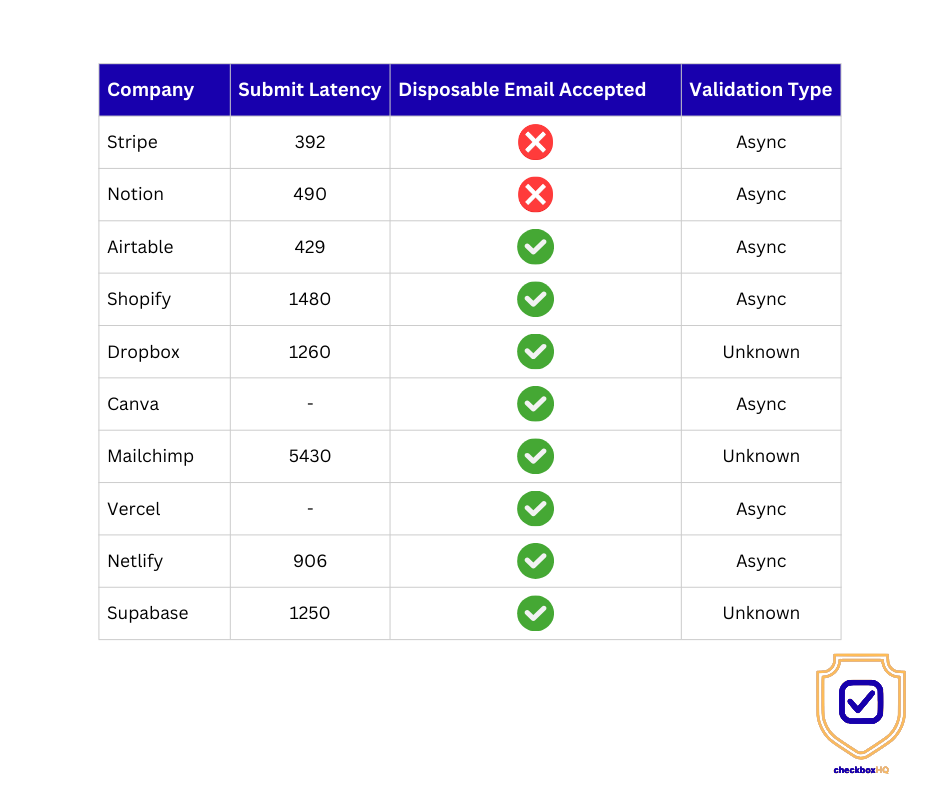
Most products allowed proceeding with the signup flow with a disposable email on the first attempt, indicating a preference for async enforcement over blocking. The blocking happened in subsequent steps/screens. Products like Dropbox, MailChimp, Supabase allowed complete account creating using disposable emails.
3. Blocking validation is non-existent
None of the products used blocking validation on the initial input. In some cases, the error message clearly mentioned that use of disposable emails is not allowed.
4. CAPTCHA is no longer a first-line defense
CAPTCHA never appeared on the first attempt, suggesting invisible or behavior-based bot mitigation.
5. Submit latency varies widely
Frontend orchestration and UX decisions often dominated perceived latency more than validation itself. Average submit latency observed was 1454.63 ms.
Key takeaways for teams building signup forms
1. Do not block on email intelligence
Allow signup first.
Flag later.
Enforce progressively.
2. Design for partial trust
Accounts do not need full trust at creation time.
Use:
- Feature gating
- Rate limits
- Verification thresholds
3. CAPTCHA should be conditional
CAPTCHA is now a response, not a default.
You might want to trigger it only after suspicious behavior.
4. Measure what actually matters
Instead of:
- Signup success rate
Measure (metrics guide):
- Activation rate
- Disposable email ratio
- Time-to-first-value
- Support cost per signup cohort
Why async validation is winning in 2026
Async validation:
- Preserves conversion
- Handles flaky dependencies
- Scales with traffic
- Allows nuanced enforcement
This benchmark strongly suggests that blocking validation is already declining among high-scale SaaS products.
Limitations of this study
- Only 10 products tested
- Manual testing (not automated replay)
- Single attempt per product
- Internal enforcement not observable
Final thought
Sign-up forms are no longer about collecting data.
They are about starting relationships at scale.
The companies that win in 2026:
- Let users in quickly
- Observe silently
- Enforce intelligently
- Optimize for long-term value
Build Smarter Sign-up Forms with checkboxHQ
At checkboxHQ, we help SaaS teams implement the exact patterns used by Stripe, Notion, and other high-growth companies:
- Async email validation that doesn’t block conversions
- Disposable email detection with configurable enforcement
- Progressive profiling to collect data without friction
Implementation Guides
- Python/Celery Backend Implementation
- Webflow + Airtable Integration
- Wix + Airtable Integration
- Full Best Practices Guide